Quick Answer
Copperhead vs rat snake: compare pattern, head shape, and habitat clues from a safe distance. No single feature confirms a species.
Why these snakes are easy to confuse
Copperheads and rat snakes can both appear brown or gray, and their markings vary with species, age, region, lighting, and viewing angle. The rat snake shown below is a Western Ratsnake (Pantherophis obsoletus) photographed in Texas; it is an example, not a template for every snake called a rat snake.
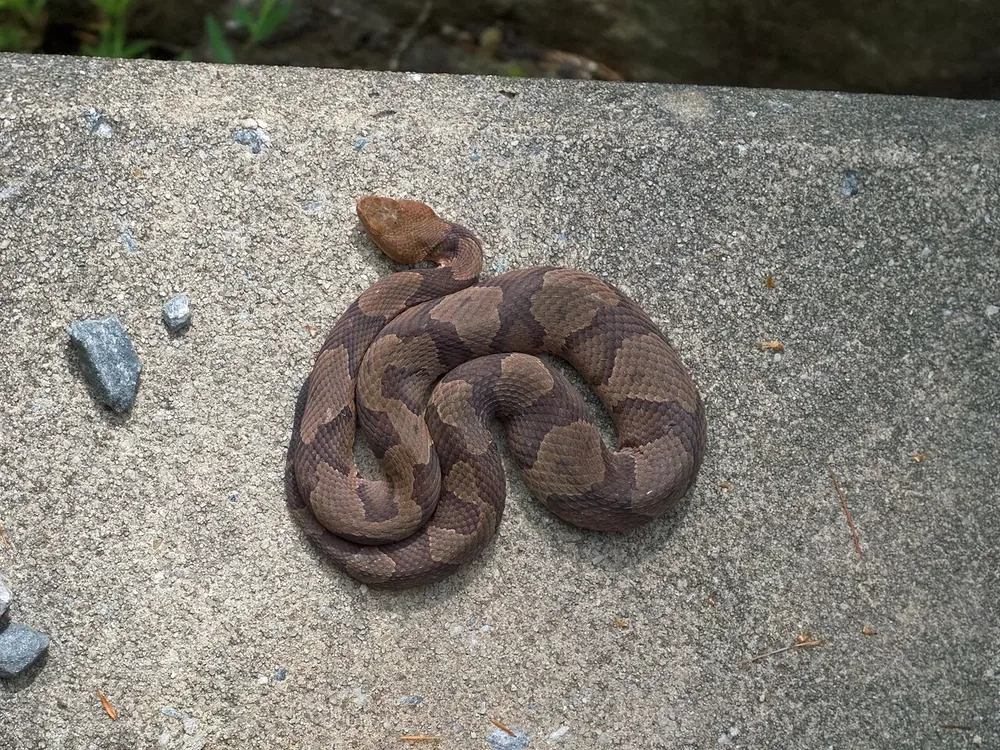
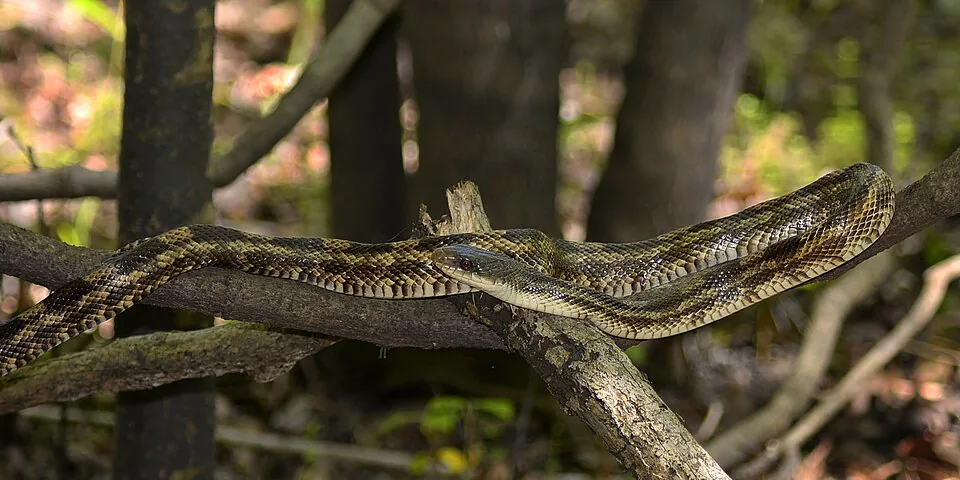
Western ratsnake photographed in Liberty County, Texas. Appearance varies by age, region, and lighting; use the photo only as a visual reference.
Use a photograph or a distant sighting only to narrow possibilities. This page cannot confirm an individual snake’s identity, and no single color, pattern, head shape, pupil, or behavior is a safe test.
Common visual clues — and their limits
| Clue | Copperhead often shows | Rat snake may show | What the clue can tell you |
|---|---|---|---|
| Body pattern | Dark chestnut or reddish-brown crossbands on a lighter body; some are described as hourglass-shaped | Blotches or saddles; colors and contrast vary, and juveniles can look different from adults | A useful comparison in a clear photo, but patterns overlap and are not a confirmation. |
| Overall appearance | Color and body shape vary across its range | Some adults become much darker; other populations remain patterned | Lighting, distance, posture, and life stage can change what you see. |
| Head, eyes, movement, or location | Can share traits people associate with pit vipers | Can flatten its head or vibrate its tail when disturbed | Do not approach to inspect these traits. They are not a safe stand-alone identification method. |
How to use the two photos
Compare the visible body markings and general appearance only. The photographs show different individual snakes under different conditions, are not to scale, and cannot establish that a snake you encounter matches either image. The ratsnake’s color and pattern are not representative of every regional population.
What not to use as an identification test
- Head shape: Harmless snakes can flatten their heads, and apparent shape changes with angle. Do not move closer to inspect it.
- Pupil shape or facial pits: These details require a close view; do not approach, restrain, or photograph a snake at close range.
- Tail vibration, climbing, or temperament: Behavior alone does not establish species or venom status.
- A single pattern or color: Variation and look-alikes make absolute rules unreliable.
If you find a snake near your home
- Stop and give it space; do not touch, corner, capture, kill, or try to move it.
- Keep children and pets away and let the snake leave if it has a clear path.
- If it is inside a building, poses an immediate concern, or cannot leave safely, contact local animal control or a qualified local professional. Do not use this page to decide whether handling is safe.
- If you already have a photo taken from a safe distance, share it with your state wildlife agency or a qualified local identifier; do not approach to get a better image.
If someone is bitten
Call 911 or local emergency medical services and seek urgent medical care. Do not try to catch the snake, cut the wound, apply a tourniquet, or suck out venom. Follow current instructions from emergency professionals.
Frequently asked questions
Can I tell a copperhead from a rat snake by its head or pupils?
No. Those features are not safe stand-alone tests, and checking them would require getting too close. Treat an unidentified snake as potentially venomous and keep back.
Does a climbing snake have to be a rat snake?
No. Climbing behavior does not reliably identify a snake. Do not use where it is found as proof of species.
Are the photos a complete field guide?
No. The images show one copperhead and one Western Ratsnake. Regional species, age, posture, and lighting create substantial variation; ask a local authority when identification matters.
Sources and review scope
- Texas Parks & Wildlife Department: Snake FAQ — notes that harmless and venomous snakes can share traits such as broad heads, vertical pupils, and tail vibration.
- Texas Parks & Wildlife Department: Venomous Snake Safety — copperhead patterns and safe coexistence.
- CDC: Snakebite response and first aid — emergency response and actions to avoid.
Official safety and species sources checked September 29, 2026 (ET). This is an educational visual comparison, not a remote identification or medical diagnosis.