Quick answer: An adult gray wolf is generally larger and more heavily built than a coyote. A coyote usually has a narrower muzzle and more prominent pointed ears. Compare several features together; a distant silhouette, one tail position or an estimated weight cannot confirm the species. If the view is poor, record it as an unidentified canid rather than forcing a wolf-or-coyote answer.
This guide compares coyotes with gray wolves. It is not a reliable test for red wolves, wolf-dog ancestry or every domestic dog breed. The two photographs are separate reference images, not animals photographed together at the same scale.
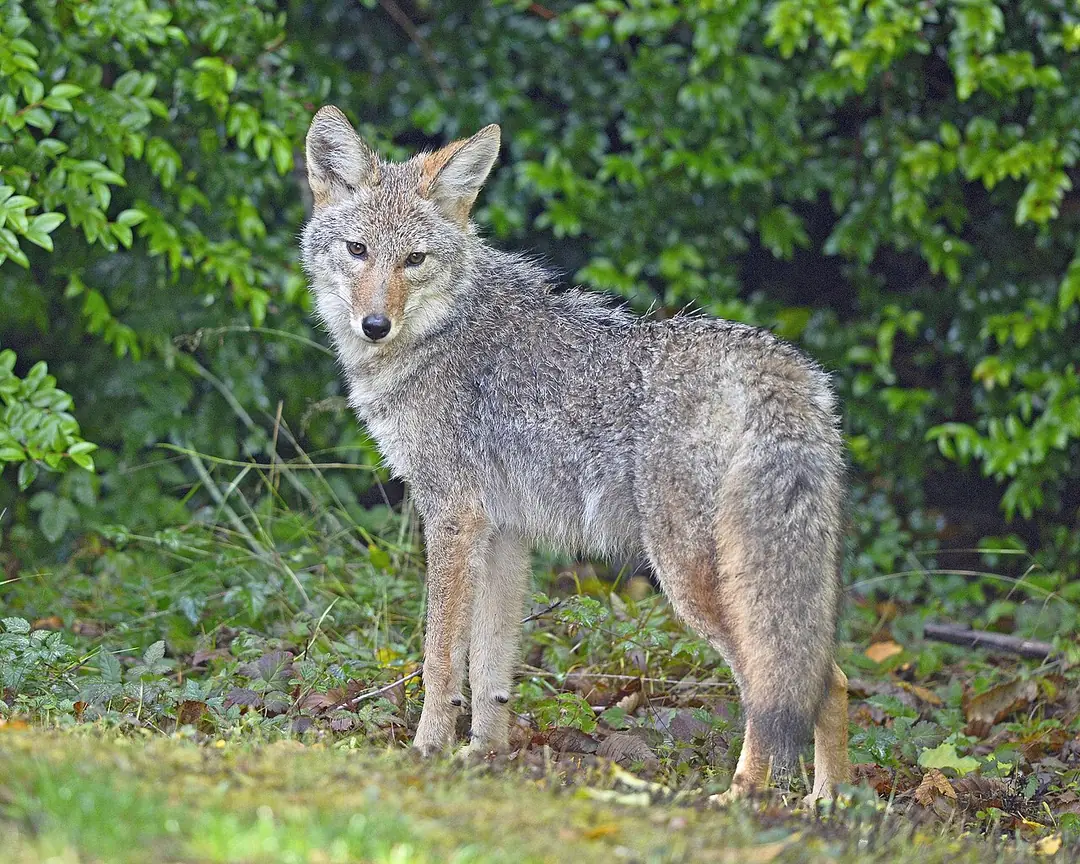
Illustrative coyote photograph; framing and apparent size are not a scale comparison or a stand-alone identification test.
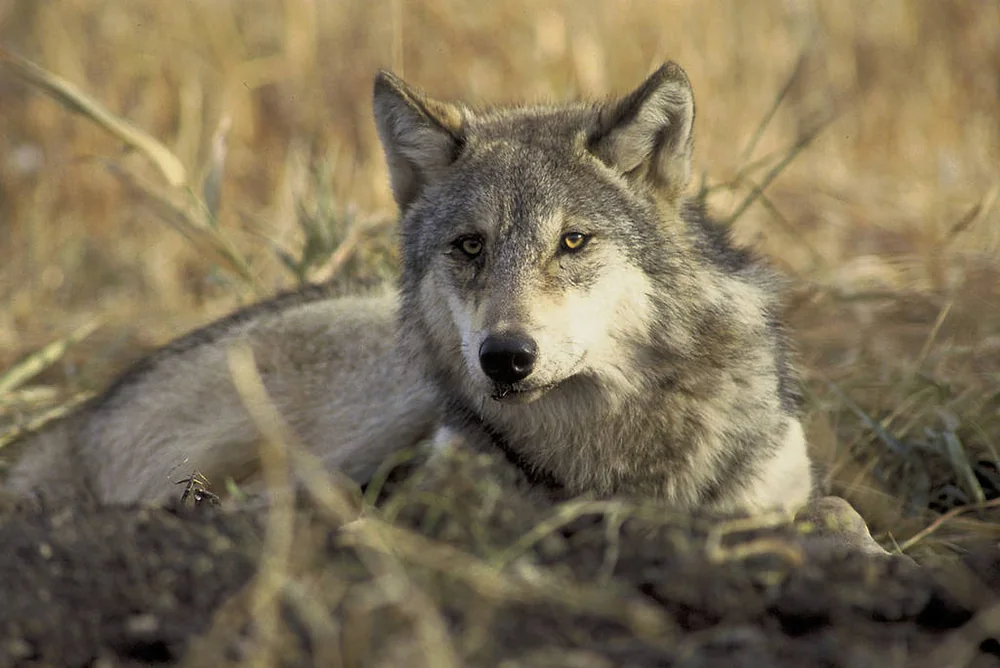
Coyote vs wolf: compare the whole animal
Start with a clear side view and, if already available, a view of the head. Do not move closer to obtain either. Winter fur, young animals, camera perspective and a partially hidden body can make a simple size comparison misleading.
On a phone, swipe the comparison table sideways. Each column describes a clue, not a conclusive test.
| Feature | Coyote | Gray wolf / caution |
|---|---|---|
| Overall build | Generally smaller and slighter than an adult gray wolf. | Generally larger, with a more substantial body. A young wolf or a large dog complicates this comparison. |
| Muzzle and ears | A narrower-looking muzzle and prominent pointed ears can support a coyote identification. | A broader-looking muzzle and less prominent ears can support a wolf identification. Angle and fur can obscure both. |
| Coat | Often mixed tan, gray and buff. | Gray wolves can also be black or white. A gray coat alone does not establish either species. |
| Tail | Observe it across several frames if possible. | A low or straight tail alone cannot distinguish a wolf from a coyote or dog. Do not use a single frame as a species test. |
| Feet and tracks | Track shape and a sequence of prints may help a qualified reviewer. | Large dog and wolf tracks can overlap. Soft snow, mud and movement alter prints; size alone is inadequate. |
| Location and behavior | Coyotes occur in urban as well as rural settings. | Location helps assess possibilities, not prove identity. Daylight activity, solitude and a howl are not automatic answers. |
The National Park Service describes difficult wolf/dog/coyote identifications when light is poor or a sighting is brief. Its North Cascades description is useful for appearance and track limitations, not as a current nationwide population count or safety guarantee.
How much bigger is a wolf than a coyote?
For a regional comparison, Yellowstone NPS lists coyotes at 25–35 pounds and 16–20 inches at the shoulder. Its wolf page lists 26–36 inches at the shoulder, with males at 100–130 pounds and females at 80–110 pounds. These are Yellowstone reference figures, not national cutoffs you can apply to an animal on a security camera.
See the separate Yellowstone coyote and wolf ecology pages. A photo usually cannot establish weight. A fence only helps with scale if its dimensions and the animal's distance from it are known; a fence farther behind the animal is not a ruler.
A practical identification sequence
- Check what is actually visible. Can you see the full body, feet, muzzle and ears, or only a blurred head? Note the missing features rather than filling them in.
- Compare proportions. Look at build, muzzle and ears together. Mark conflicting clues; do not let one striking feature overrule the rest.
- Consider a domestic dog. A collar is useful if visible, but its absence does not prove a wild animal. Large dogs can resemble wolves.
- Check local official information. Use the wildlife agency's current guidance for the actual location, not a static list of states on an old article.
- Keep an uncertain result uncertain. If the distinction would determine a trapping, hunting or removal decision, obtain agency guidance before acting.
For example, a large-looking animal behind a night-camera glare with no visible feet or muzzle remains unresolved. A clear, repeated side view with several matching features is more useful than an enlarged, sharpened crop. Image enhancement cannot recover measurements that were never captured.
Eastern coyotes and “coywolf” claims
A large eastern coyote does not become a confirmed wolf or recent hybrid because it looks heavy. Maine's wildlife agency records occasional coyotes over 50 pounds and asks for reports of unusual animals. Its rare-mammal identification guidance also explains how track appearance changes with the surface and the animal's movement.
Coat, size and a photograph do not establish an animal's ancestry. Avoid assigning a genetic percentage or a “coywolf” label from appearance. An agency may need better observations or other evidence to assess an unusual sighting.
What to record for a useful sighting report
- State, county, date and approximate time; give precise location privately to the agency rather than publicly advertising a den.
- The original image or video, including several frames if available. Retain the unedited file.
- Which features you observed directly and which are estimates: body, ears, muzzle, tail, feet and nearby scale reference.
- The direction of travel and any repeated visits. Describe behavior rather than declaring the animal sick or dangerous.
Find the correct agency in our state wildlife agency directory. A sighting report is not permission to approach, capture or kill the animal. This website does not offer remote species certification or a removal service.
Safe next steps while identification is uncertain
Keep people and pets away, observe from a protected position and do not feed or follow the animal. NPS recommends distance and binoculars instead of approaching for a closer view; follow the local park or agency's specific instructions. See NPS wildlife-watching guidance. For an immediate threat, seek local emergency help rather than waiting for an online identification.
Frequently asked questions
Is head shape enough to identify a coyote?
No. Muzzle and ear proportions are useful clues, but angle, fur and an incomplete view can hide them. Compare the whole animal and consider dogs and young animals.
Does a tail held down mean it is a wolf?
No. One tail position is not a conclusive wolf/coyote test. Keep several frames and look for other features.
Can there be a wolf outside a familiar range map?
Do not treat an old map as proof that an animal must be a coyote. Ask the local wildlife agency about current observations and reporting procedures.
Can I identify a wolf from one footprint?
Not reliably from size alone. Large dogs can make similar prints, and the surface can distort them. A clear sequence and context are more useful, but uncertainty may remain.
Appearance and observation sources reviewed October 5, 2026. Regional measurements are labeled above. This review does not certify an individual animal, update every state's wolf status or establish a legal removal method.