Not until you know what you would be closing. A shallow crossing beneath a fence, an entrance into a deeper burrow, and soil washed out beneath a panel need different responses. Keep pets away, leave an uncertain opening undisturbed, and record where it leads before arranging repairs.
The frustrating part is not just the gap. It is deciding whether filling it will solve the problem or shut an animal inside. Start with the destination of the opening, not a guess based on its diameter. This guide is for an ordinary residential fence line, not a failing retaining wall or an animal currently trapped or injured.
First, check where the opening goes
Look from a safe standing position on your own property. Do not reach into the opening, crawl under a fence, or enter a neighbor's yard without permission. These are observation categories, not a wildlife identification test:
- A visible crossing: a shallow worn path appears to continue beneath the panel and out the other side. Record the route and any animal actually seen using it. That does not establish that every nearby hole is empty.
- A possible entrance: the opening disappears underground or runs toward a shed, deck, or other sheltered space. Leave it open while occupancy is assessed. An entrance beside a fence post is still an entrance, not automatically a harmless shortcut.
- A soil or fence problem: the gap follows a sagging panel, a runoff channel, or disturbed ground without a clearly observed animal. Record rain and fence condition as well as animal activity. A barrier will not address a drainage or support problem by itself.
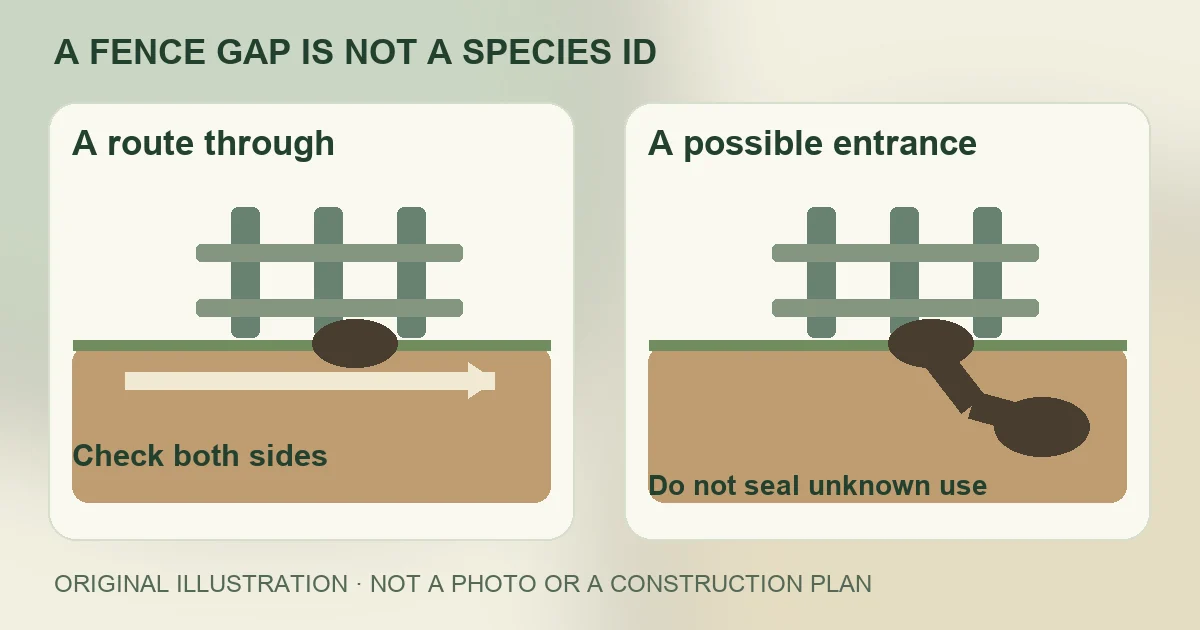
If it leads beneath a building rather than simply across a fence, use the under-porch occupancy checklist as the next step. Do not block the fence route while another possible entrance remains unexplained.
Can the hole tell you which animal made it?
Not reliably on its own. The University of Maine describes woodchuck burrows with more than one opening, including concealed exits, and notes that other animals may reuse them. UC IPM also describes skunks using abandoned burrows. The current visitor need not be the original digger.
A photograph of the opening is useful for describing the site, but a confidently named animal requires more evidence. A direct observation or a clear camera view is more useful than a “three-inch hole equals this species” chart. Photograph without baiting the opening or putting a camera inside it. If footage is unclear, record “unknown animal” rather than arranging species-specific treatment on a guess.
What to do while you are checking
Use a different part of the yard for pets and children, away from the opening. Do not tether a dog beside it or encourage a dog to investigate. Keep a clear, undisturbed route for any animal already using the site.
You can also check ordinary food sources elsewhere in the yard: secure garbage lids, remove outdoor pet food, and pick up spilled birdseed or fallen fruit. UC IPM identifies these as food sources that can attract skunks. This is an attractant check, not evidence that your visitor is a skunk and not a guarantee that an occupied burrow will be abandoned.
Do not pack the opening with rocks, inject foam, pour chemicals into it, flood it, or improvise a one-way door. A blocked exit and dependent young are separate risks from the damage to the fence.
A useful record before you call anyone
You do not need to stand outside all night or disturb the site. Make a short record from a safe location:
- Give the gap a location. Use a fixed landmark such as “third panel from the gate.” Photograph the whole fence section and then the opening with zoom.
- Describe the visible destination. Does the route emerge on the other side, disappear underground, or continue toward a structure? Write “not visible” when you cannot tell.
- Record use, not just appearance. Note any animal actually seen, the time, and the direction of travel. Separate direct observations from guesses about tracks or digging.
- Note what changed. Include recent rain, fence work, filling, planting, or a pet digging in that area. These are possible context, not a diagnosis.
- List connected locations. Note other openings seen from accessible ground, including gaps around a shed or deck. Do not probe a tunnel to find its end.
- Explain your repair goal. Are you trying to keep a dog inside, prevent repeated digging, fix a loose post, or address an animal living underneath a structure? Tell the person you contact which decision you need help with.
A concise message is enough: “There is an opening beneath the rear fence, beside the shed. I cannot see where it ends. I saw an animal enter at dusk, but the footage does not identify it. I have not filled it. I need occupancy checked before a fence repair.”
When is it safe to fill or screen the gap?
A quiet day, a cold week, or one clip of an animal leaving is not a universal vacancy test. Humane World warns that exclusion can trap residents or separate young from an adult. Maine's woodchuck guidance also describes hibernation; a season with little visible activity is not necessarily an empty burrow.
Where the opening may be a den, ask a qualified local wildlife professional to explain how occupancy and dependent young will be assessed before exclusion. Do not assume a calendar month makes the work safe nationwide. Ask which species and local restrictions apply to the proposed method; the state wildlife agency directory provides a starting point, not permission to trap or relocate an animal.
If the gap is instead an ordinary crossing and occupancy concerns have been resolved, discuss the repair with the fence installer. Record which connected gaps, panel attachments, and ground conditions the repair will address. Closing only the most noticeable spot may leave the same route available beside it.
Will an underground mesh barrier stop the digging?
It can be appropriate for a confirmed digging problem, but it is not a universal specification. Humane World's fence guidance describes an L-shaped mesh barrier that extends outward at ground level or below it. Mesh size and installation depend on the animal and the site. A fence may also be climbed: Maine's woodchuck guidance describes both digging and climbing, so digging protection alone does not establish full exclusion.
Ask an installer to explain these choices before agreeing to work:
- Which observed animal or damage pattern is the design intended to address?
- How will the barrier attach to the actual fence and continue past gates or uneven ground?
- Will installation preserve drainage and avoid exposed sharp edges?
- How will the worker avoid blocking an occupied opening during installation?
Before anyone disturbs the ground, contact your state's 811 service and follow its instructions. The national 811 guidance applies even to small digging projects such as fences. Wait for the required responses and markings; do not substitute a generic waiting period from another state for your local instructions.
Who should handle which part?
- Unknown use, a suspected den, or dependent young: start with the local wildlife agency's guidance or a qualified wildlife professional. Confirm any required authorization for the method before work begins.
- A loose panel or ordinary fence repair after occupancy is resolved: a fence contractor can assess attachment and barrier options. Ask for the scope in writing; this website does not quote, book, or dispatch that service.
- Washed-out soil, a leaning support, or an opening beside a retaining structure: seek an appropriate drainage or structural assessment. Do not excavate to investigate a suspected void.
- An animal trapped, injured, or inside the house: contact the appropriate local animal/wildlife authority for situation-specific help instead of continuing fence work.
For a shared fence, show the neighbor your observation record and agree on access before arranging work. The property arrangement does not determine wildlife permissions; do not assume the person who owns the fence may use any removal method.
If another hole appears after the repair
Compare its position with your original photograph before assuming the same animal defeated the barrier. Is it beside a gate, beyond the repaired section, at a new location, or actually a runoff gap? Keep the new opening undisturbed if its use is uncertain, and ask the installer to review the recorded scope.
The repeated yard-hole checklist separates reopened entrances, fresh feeding pits, raised runways, and soil settling. Use it if the problem extends beyond the fence line; this page is specifically about deciding what can be closed beneath a fence.
Sources and limits
Sources reviewed October 9, 2026 (U.S. Eastern operating date). The observation categories and message checklist are editorial aids, not a property inspection, species diagnosis, or legal authorization. The sources below support particular biological or prevention points, not every local situation. No photographs or text have been copied from these organizations.
- Humane World for Animals: animals digging or burrowing under fences — barrier concepts and occupied-burrow precautions.
- University of Maine Cooperative Extension: managing woodchucks — multiple entrances, reuse, climbing, and hibernation; not a national removal-law guide.
- University of California IPM: skunks — burrow reuse and residential food sources. Its California legal discussion is not generalized here, and its capture or chemical instructions are not reproduced.
- 811: before you dig — contact the state service and follow local marking and response instructions.