The Fastest Way to Tell Them Apart
At a glance, a raccoon usually shows a dark eye mask and a furry, ringed tail; a Virginia opossum has a pale face, pointed snout and a nearly hairless tail. The photos below let you compare faces directly. If you can see the tail safely, it is a stronger clue than whether the animal freezes, hisses or moves quickly. Do not approach an animal just to check a field mark.

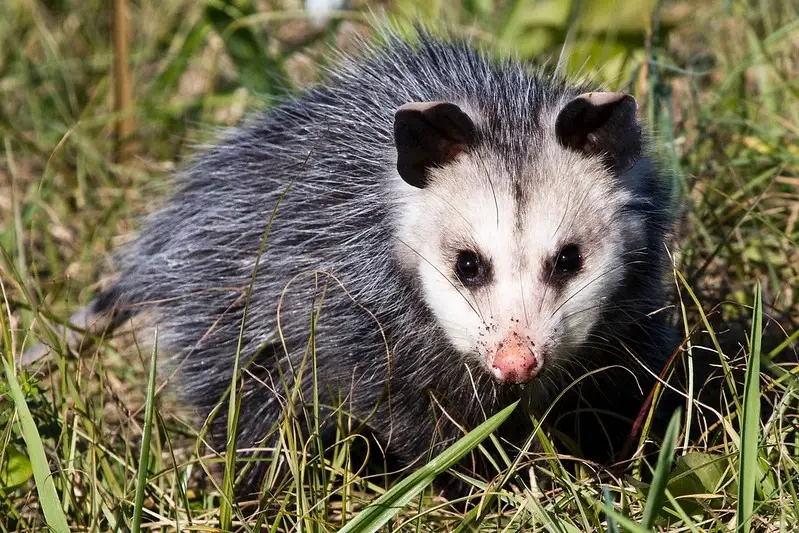
Side-by-Side Look
| Feature | Raccoon | Opossum |
|---|---|---|
| Size | 12–20 lbs, solid build | 4–14 lbs, lighter frame |
| Face | Black "mask" over eyes | White, pointed snout, pink nose |
| Ears | Rounded, dark, upright | Large, rounded, dark edges on pale fur |
| Tail | Bushy with dark rings | Long, thin, nearly hairless pink/grey |
| Teeth | Not obvious | 50 teeth, often bared when threatened |
| Behavior when scared | Backs away, may growl, climbs quickly | Freezes, hisses, or plays dead |
| Activity | Primarily nocturnal | Nocturnal, more opportunistic |
Distinguishing the Tracks
If you only see prints, both show five toes — the confusion happens there. Look closer:
Raccoon prints are larger (2–3.5 inches), with five long finger-like toes that spread almost like a tiny hand, and it usually shows clear claw marks. In mud, the print looks deliberately "handed."
Opossum prints are smaller and splayed, and the rear-foot inner toe sticks out sideways at a heavy angle — like a thumb pointing to the side. No raccoon shows that angled "thumb," so it's the single reliable track separator.
Distinguishing the Scat
Raccoon scat: tubular, 3/4 to 1 inch in diameter, blunt-ended, and often full of visible seeds and berries. Raccoons use latrines: repeated piles all in one spot, typically on a roof, fence top, log, or flat surface. The smell is strong and penetrating.
Opossum scat: smaller — about 1/4 to 1/2 inch — grey-brown, and pointed at both ends. Opossums don't form latrines, so droppings tend to be scattered singly in corners and trails.
A repeated pile on a raised surface can suggest a raccoon latrine, but droppings alone cannot confirm the species. Do not touch or sweep an unknown pile to make an identification.
Damage Differences for the House and Yard
Their physical habits create different damage, which helps when you never see the animal:
Raccoon damage is destructive and structural. Ripped or dented roof shingles, pulled-apart vents, toppled trash cans with a chewed lid, and long strips of turf pulled up when hunting grubs. Raccoons are adept climbers and can open a loose fastener.
Opossum damage is minimal. They don't dig burrows, rarely tear shingles, and don't gnaw their way in. Their main issues are using an existing opening into a crawlspace or attic, tipping open trash, and leaving a mess — not structural harm.
Rule of thumb: if you have torn shingles or a damaged roof entry, lean raccoon. If things are disturbed but no real damage, lean opossum.
Sounds at Night
Raccoon: low chittering, soft growls, and occasional shrill screams when two fight. On a roof you hear heavy, deliberate thumping.
Opossum: mostly quiet; you'll hear a slow, stumbling footfall and, if cornered, a startling hiss-and-drop of its jaw showing all 50 teeth. It sounds threatening but is a bluff.
Which One Should You Worry About?
Neither animal should be approached or cornered. An opossum may move through without staying, while a raccoon can reuse a secure den; neither pattern guarantees what is happening at your house. A suspected raccoon latrine in an attic or under a deck calls for careful assessment rather than casual cleanup.
A suspected raccoon latrine deserves special care because roundworm eggs may be present even when they are not visible. Do not touch, sweep or vacuum the pile. CDC cleanup guidance says most chemicals do not kill the eggs, so a 10% bleach recipe is not an adequate instruction. Keep children and pets away; for an attic or other enclosed area, ask a qualified cleanup professional or local animal control for site-specific help.
What Actually Works to Get Rid of Them
For opossums: remove pet food, secure compost, and block the entry at night after it leaves. Most move on in a few days once the free meal disappears.
For raccoons: you need secure, locking trash bins, trimmed tree limbs back from the roofline, capped chimney and roof vents, and entry gaps sealed with hardware cloth. Raccoons are determined, so temporary fixes fail — do the seal properly or a pro will be cheaper in the long run.
Never seal an opening while an adult or young may still be inside. Have the entry and den assessed before exclusion or repair; a temporary plug is not proof that the space is empty.
Already in the attic, or a raccoon family under the house? That's a job for a licensed pro — don't seal it blind. Compare free quotes from insured local wildlife services.
Frequently Asked Questions
Are raccoons more dangerous than opossums?
Do not corner either animal. Raccoons are stronger and may defend a den; a suspected raccoon latrine can pose a Baylisascaris roundworm exposure risk. Keep people and pets away and follow the CDC guidance linked above before anyone cleans the area.
How can I tell which one is in my attic at night?
Uniform heavy thumping and chittering usually means raccoon; slow, stumbling footfall with little noise usually means opossum. Check for a scat latrine (raccoon) versus scattered small droppings (opossum).
Do opossums dig holes?
Virginia opossums usually use existing shelter rather than excavating a burrow. Fresh digging alone cannot identify the animal; compare the hole, tracks and any safe-distance sighting before deciding what to do.