Quick Answer
A snake barrier is worth considering for a small, fully enclosed play area or a yard with repeated encounters with ground-dwelling venomous snakes. A standard privacy fence is not one. University guidance calls for openings no larger than ¼ inch—including gates and drains—at least 36 inches of height from the nearest climbable surface, and a buried lower edge. Even a well-built barrier cannot promise a snake-free yard: climbing species, vegetation bridges and an unnoticed gap can defeat it.
Most homeowners do not need to fence an entire property to deal with one snake sighting. First ask what you need to protect: the house, a play area, or every square foot of the yard? Those are different jobs. A tight garage-door seal and fewer rodent attractants may matter more than a new perimeter fence if the real problem is a snake entering a building.
Start With the Place You Need to Protect
A snake is inside the house or garage: A yard fence does not solve an existing entry point. Keep people and pets away from the animal. Do not try to handle an unidentified snake; contact local animal control or a qualified snake-removal professional when it may be venomous. After the space is clear, inspect the door sweep, utility openings and foundation gaps. UC IPM specifically notes that gaps under garage doors and around crawl spaces can provide access.
Snakes repeatedly cross a small play area: A closed barrier may be practical because gates, drainage points and maintenance are easier to inspect. Colorado State University Extension describes fencing around backyards or play areas in rattlesnake areas; UC IPM notes that play areas are one setting where the expense may be justified.
You saw one snake outdoors: Give it space and reduce food and cover before buying a fence. Snakes often pass through. A fence cannot compensate for rodent food, dense vegetation or woodpiles pressed against it. If you are not sure what snake you saw, start with the existing copperhead and rat-snake visual guide or your state wildlife agency—not a close-up handling attempt.
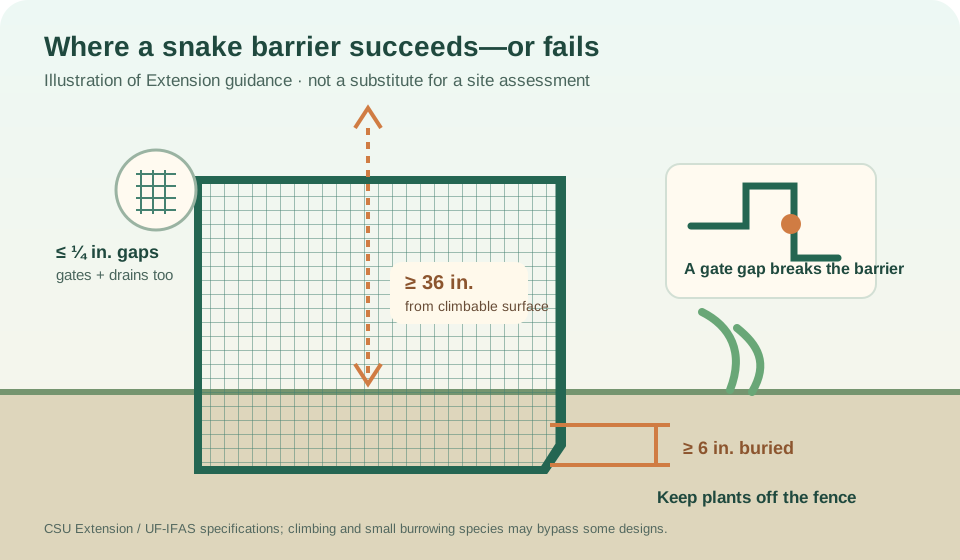
The Five Places a Barrier Usually Fails
- Mesh or panels: Choose a continuous smooth barrier or mesh with openings no greater than ¼ inch. Large decorative-fence gaps, chain-link openings and loose seams leave a route through.
- Height: UF/IFAS recommends at least 36 inches above the nearest climbable or flat surface—not merely 36 inches above the soil. A raised planter or stacked material alongside the fence changes the effective height.
- Bottom edge: Where a mesh barrier meets soil, UF/IFAS advises trenching it at least 6 inches deep and angling it slightly outward. Check for washouts and soil movement after storms. A gap at the bottom can undo the rest of the work.
- Gates and drains: Measure the actual clearance when the gate is closed. Check hinges, corners, threshold, drainage outlets and where a fence meets a wall. UF/IFAS warns that a perimeter that cannot be fully enclosed—including gates and drains—should not be treated as snake exclusion.
- Climbing routes: Keep vegetation and stored items away from the barrier. UC IPM notes that plants and debris can give snakes a route over the top; UF/IFAS cautions that climbing snakes and coral snakes may bypass designs effective against larger ground-dwelling species.
Before a contractor leaves: walk the entire perimeter with them. Inspect the gate in its closed position, the wall connections, drains and any slope change. Ask who will fix gaps after settling, landscaping or storm damage. A quote that specifies only linear feet of mesh does not describe a complete exclusion system.
When a Fence Is the Wrong First Purchase
If the snake is using a gap beneath a shed or a rodent burrow, address the source of cover and prey. Our snake-hole versus rodent-hole guide explains why a hole cannot establish that a snake made it or is still inside. Do not reach into, flood, poison or seal an occupied opening.
Likewise, do not use mothballs, sulfur or a marketed repellent as a substitute for exclusion. Colorado State University Extension found insufficient evidence to recommend snake repellents. If the concern is snakes entering a house, focus on building openings; if it is repeated encounters in a small area, then price a properly closed barrier.
What a Useful Fence Quote Should Specify
- The exact area being enclosed and whether the line can be continuous.
- Barrier material, maximum opening size and measured height from climbable surfaces.
- Buried-edge method for soil sections and a plan for concrete, slopes and retaining walls.
- Gate thresholds, drains, utility passages and connections to buildings.
- How an animal already inside the proposed enclosure will be dealt with safely before closure.
- Inspection schedule and who repairs gaps after weather or landscaping work.
Do not accept a claim that any fence is 100% snake-proof. Ask which local species it is designed to exclude. Requirements for capturing, moving or harming wildlife vary by species and jurisdiction; construction guidance is not permission to handle a snake. Check your state wildlife agency and local building or property rules before work begins.
Questions Homeowners Usually Have
Will an ordinary wooden privacy fence keep snakes out?
Not reliably. A privacy fence can still have open bottoms, post gaps, gates and drainage routes. Judge the complete perimeter, not the panel material.
Should I fence the whole yard or only a play area?
Start with the smallest area that solves the actual problem. Whole-yard fencing can be expensive and difficult to close at every gate, drain and grade change. UC IPM identifies children’s play areas as one situation where a more limited barrier may be worthwhile.
Can a snake climb over a 36-inch fence?
Yes, some snakes can climb, especially if vegetation, posts or stored items offer a route. The 36-inch measurement is a design recommendation for certain exclusion systems, not a promise against every species.
Is snake fencing required by state law?
No nationwide residential snake-fence rule is established by these sources. The measurements above are university Extension guidance. Species protection, removal rules and local construction requirements are separate questions to verify for your address.
Sources and Review Scope
- University of Florida IFAS: Coexisting with Venomous Snakes — gap, height, buried-edge and limitation guidance.
- Colorado State University Extension: Coping With Snakes — residential prevention, play-area barrier and repellent evidence.
- University of California IPM: Rattlesnakes — habitat modification, building entry and barrier maintenance.
Sources reviewed September 21, 2026 (ET). This is a homeowner decision guide, not a construction specification, wildlife-handling instruction or state-law determination.